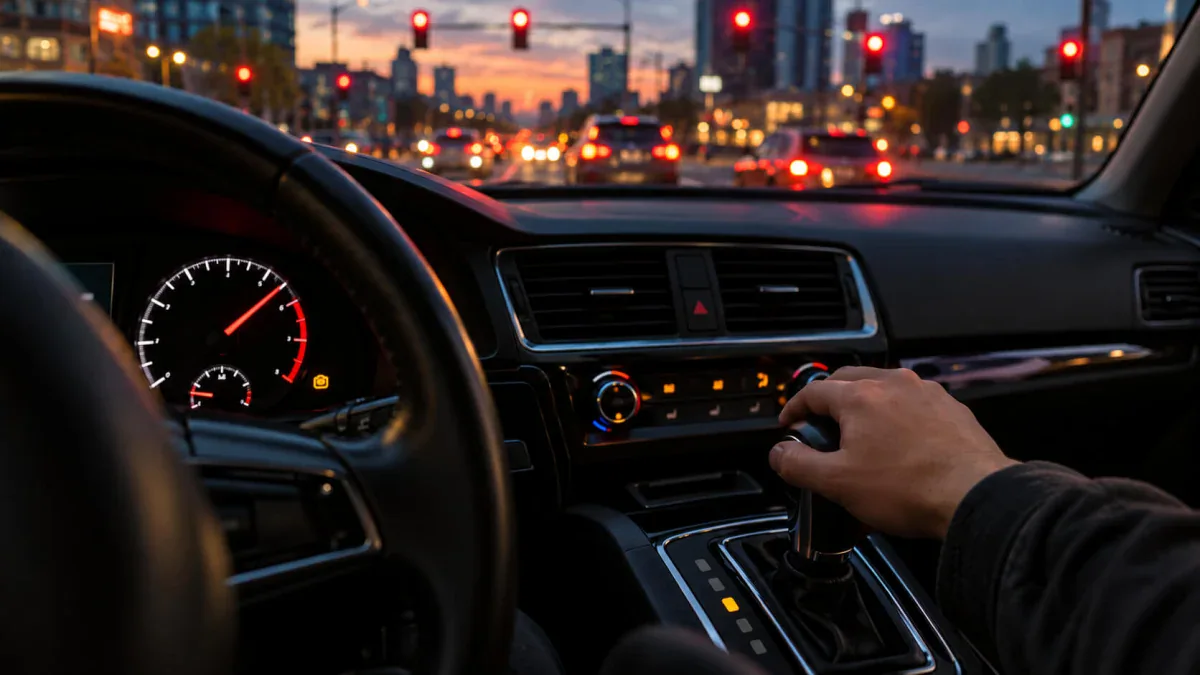
The light turns green on Glenstone Ave. You press the gas, the engine revs higher, but the car barely picks up speed. A second later it catches with a jolt and you’re moving again. If that sounds familiar, your transmission may be slipping, and the big question is whether you can keep driving or whether it’s time to call a tow truck.
Short answer: You can sometimes drive a short distance on a transmission that slips now and then, but it isn’t safe or smart to keep driving on it. If the slipping happens often, gets worse, comes with a burning smell or a warning light, or the car won’t move in drive or reverse, stop and have it towed to a shop. Driving on it can turn a repair into a full transmission replacement.
What does a slipping transmission feel like?
A slipping transmission doesn’t hold the gear it’s supposed to be in. The engine is working, but the power isn’t reaching the wheels the way it should. Common signs:
- The engine revs up but the car doesn’t speed up to match.
- Delayed engagement: you shift into drive or reverse and nothing happens for a second or two.
- Hard or jerky shifts, a clunk or a jolt when the car changes gears.
- The car seems to shift for no reason, or slips out of gear on its own.
- A burning smell, often from overheated transmission fluid.
- A check engine or transmission warning light on the dashboard.
- Whining, humming or grinding noises that change with speed.
In a car with a manual transmission, slipping usually feels like the engine revving while you’re accelerating in gear, especially going up a hill. That often points to a worn clutch.
Why do transmissions slip?
Only a mechanic can tell you exactly what’s wrong, but these are the usual suspects:
- Low or old transmission fluid. Fluid cools the transmission and helps it hold each gear. A leak or fluid that’s worn out can cause slipping.
- Overheating. Long climbs, towing a trailer or stop-and-go traffic can heat the fluid until it stops doing its job well.
- Worn internal parts, like clutch packs or bands inside an automatic transmission.
- Electrical or sensor problems. Modern transmissions are controlled by a computer and solenoids. A bad sensor can cause strange shifting.
- A worn clutch in a manual car.
Some of these are fairly simple to fix when they’re caught early. Most of them get worse, and more expensive, the longer the car is driven.
Can you keep driving? A quick guide
Here’s a simple way to think about it. When in doubt, choose the safer option.
| What you notice | What it may mean | Drive or tow? |
|---|---|---|
| One small slip, then it drives normally | Early warning, possibly low fluid | Drive carefully and straight to a shop soon |
| Slips often, especially when accelerating | The problem is getting worse | Tow it |
| Burning smell or smoke | Overheated fluid or parts | Stop now and tow it |
| Won’t move in drive or reverse | Serious internal problem or no fluid | Tow it |
| Red fluid leaking under the car | Transmission fluid leak | Tow it, so it doesn’t run dry |
| Warning light plus slipping | The car’s computer has detected a problem | Tow it |
Why driving on a slipping transmission is risky
It’s tempting to “just make it home.” Here’s why that often backfires:
- Damage spreads. Slipping creates heat and friction. Parts that could have been repaired can wear out, and a repair can become a full replacement.
- You can lose power at the worst moment. Merging onto I-44 or US-65, climbing a hill, or pulling out onto a busy road like Sunshine St or Battlefield Rd all need the transmission to respond right away.
- You can get stranded in a worse spot. A car that quits in a travel lane or on a highway ramp is much more dangerous than one that’s towed from your driveway.
What to do if it starts slipping while you’re driving
- Ease off the gas and avoid hard acceleration.
- Turn on your hazard lights if you’re losing speed.
- Get off the road safely: a shoulder, a side street or a parking lot. On the James River Freeway or I-44, take the next exit if you can do it safely.
- Park and turn the engine off if you smell burning or see smoke.
- Don’t keep “testing” it by driving back and forth. That can make the damage worse.
- Call a tow and tell the dispatcher it’s a transmission problem.
If you’re ever in danger, or there’s smoke or fire, get everyone out of the vehicle and away from traffic, and call 911.
Why a slipping transmission is usually towed on a flatbed
When the transmission isn’t working right, the safest tow is one where the drive wheels don’t turn on the road. On a flatbed, the whole vehicle rides on the bed with all four wheels off the ground, so the transmission isn’t spinning while it’s moved. This matters most for all-wheel-drive and four-wheel-drive vehicles, where towing with wheels on the road can damage the drivetrain.
For some front-wheel-drive cars, a wheel-lift tow that lifts the drive wheels can also work. At StreetSide Roadside & Towing Corp., we ask about your vehicle first and choose the safer option. See light duty towing for cars, SUVs and pickups.
Quick checks before you call the shop
- Check the fluid, if your car has a transmission dipstick. Your owner’s manual explains how. Many newer cars don’t have one, and that’s normal.
- Look under the car for reddish or brown fluid where you park.
- Note when it happens: only when cold, only on hills, only at certain speeds. Your mechanic will want to know.
- Check for recalls on your vehicle with the NHTSA recall lookup at nhtsa.gov/recalls. Some transmission problems are covered by a recall.
In Springfield and Greene County
StreetSide Roadside & Towing Corp. is based in Springfield, MO 65804 and tows cars, SUVs and pickups with transmission trouble to the repair shop, dealership or home you choose. We also serve nearby towns like Nixa and Republic. If your car is slipping and you’d rather not risk the drive, call us.
Frequently asked questions
How long can you drive with a slipping transmission?
There’s no safe number of miles. Some cars slip for a while before failing, and some fail quickly. If it’s slipping often, getting worse, or comes with a burning smell or warning light, stop driving and have it towed.
Can low transmission fluid cause slipping?
Yes. Low or worn-out fluid is one of the most common causes. Topping it off doesn’t fix a leak, so have a mechanic look at it soon.
Is it safe to drive on the highway with a slipping transmission?
No. Highways like I-44 and US-65 need quick, steady power for merging and passing. Losing power there is dangerous. Have the vehicle towed instead.
Should a car with a bad transmission be towed on a flatbed?
Often, yes, especially all-wheel-drive and four-wheel-drive vehicles. A flatbed keeps all four wheels off the road, so the transmission isn’t turning during the tow. We’ll ask about your vehicle and choose the safer option.
Can you tow my car to the transmission shop I choose?
Yes. Tell us the shop’s name or address when you call, and we’ll deliver your vehicle there.
Transmission slipping in Springfield?
Don’t risk getting stranded on the highway. Call StreetSide Roadside & Towing Corp. at (417) 427-3854. We’re available day and night.
Related: Flatbed Towing · Light Duty Towing · Roadside Assistance